
- Professional damage documentation provides clear, time-stamped evidence of the cause, scope, and severity of water damage, significantly increasing the likelihood of faster approvals and full insurance compensation.
- Comprehensive reports, moisture mapping, detailed estimates, and mitigation logs help prevent claim delays, underpayment, and disputes by aligning with insurance industry standards and adjuster requirements.
- Restore Aid Recovery supports property owners by delivering thorough documentation, structured reporting, and professional communication with insurers to protect both the property and the financial outcome of the claim.
Water damage is one of the most disruptive events a property owner can experience. Whether caused by a burst pipe, appliance malfunction, roof leak, storm intrusion, or sewage backup, the physical destruction is often only the beginning. The next challenge is navigating the insurance claim process, which can quickly become overwhelming without proper guidance and preparation. While many homeowners assume that filing a claim is straightforward, the reality is that the strength of your claim depends largely on the quality and accuracy of the documentation provided.
Professional damage documentation plays a critical role in determining how efficiently your claim moves forward and how much coverage you ultimately receive. Insurance companies rely heavily on documented evidence to validate the cause, scope, and extent of damage. Incomplete or poorly organized documentation can result in delays, partial payouts, or even denials. On the other hand, thorough, structured, and professionally prepared documentation significantly increases the likelihood of a smooth approval process and full compensation for covered losses.
Understanding how documentation influences the claims process is essential for protecting both your property and your financial investment.
Understanding the Insurance Claim Process After Water Damage
Before examining how professional documentation makes a difference, it is important to understand how water damage insurance claims are evaluated. When you report a loss, your insurance carrier assigns an adjuster to investigate the claim. The adjuster’s responsibility is to determine the cause of damage, confirm that the loss is covered under your policy, assess the extent of damage, and calculate the cost of repair or restoration.
Insurance carriers do not rely solely on verbal descriptions or visual walk-throughs. They require detailed evidence. This evidence must demonstrate that the damage occurred suddenly and accidentally if that is what your policy covers. It must also establish the timeline of events and show that reasonable steps were taken to mitigate further damage.
Without comprehensive documentation, adjusters may question the scope of damage, suspect pre-existing conditions, or reduce compensation based on insufficient proof. In many cases, disputes arise not because coverage is unavailable, but because documentation fails to clearly support the claim.
The Critical Role of Accurate and Timely Documentation
The difference between a smooth claim and a prolonged dispute often lies in documentation prepared during the earliest stages of mitigation. When water damage occurs, moisture spreads rapidly through porous materials such as drywall, insulation, flooring, and framing. Within hours, structural components begin to absorb water. Within days, microbial growth may begin.
Insurance carriers expect policyholders to act promptly. Proper documentation establishes that mitigation began quickly and that additional damage was not caused by neglect. Time-stamped records, moisture readings, and inspection reports provide objective proof that supports the legitimacy of your claim.
Professional documentation captures the condition of the property before demolition or drying begins. This step is crucial because once materials are removed, the visible evidence is gone. Without pre-mitigation documentation, it can be difficult to demonstrate the true extent of the loss.
What Professional Damage Documentation Includes
Professional documentation goes far beyond taking a few photographs. Restoration specialists utilize systematic processes designed to capture comprehensive evidence that aligns with insurance industry standards.
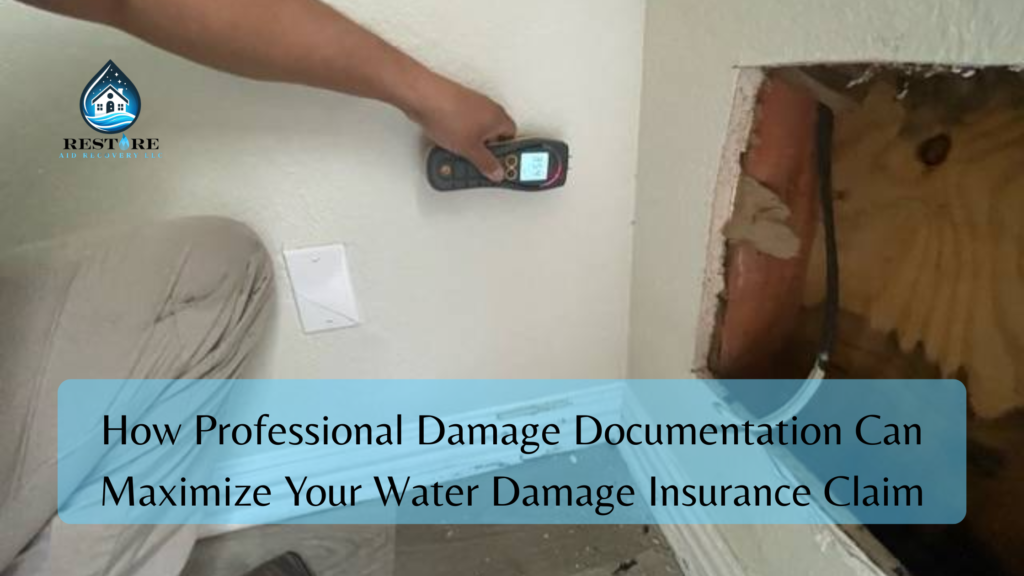
Detailed photographic and video documentation records each affected area from multiple angles. These images are time-stamped and organized by room, creating a clear visual record of damage progression. Moisture mapping is another essential component. Using specialized meters and thermal imaging technology, technicians identify hidden moisture pockets within walls, ceilings, and flooring. The results are recorded in structured reports that demonstrate both visible and concealed damage.
Written loss reports provide narrative explanations of the cause of damage, affected materials, and recommended mitigation procedures. These reports often include diagrams or floor plans outlining impacted areas. Professional estimators prepare itemized repair scopes using industry-standard software to calculate material, labor, and equipment costs accurately.
Air quality data, microbial assessments, and environmental readings may also be documented when applicable. Each of these components strengthens the claim by reducing ambiguity and aligning with insurer expectations.
Establishing the Cause of Loss
Insurance coverage depends heavily on the cause of damage. Policies often differentiate between sudden and accidental water damage and long-term neglect or maintenance issues. Proper documentation helps establish the origin of the loss and confirms whether it meets policy requirements.
Professional inspectors identify the source of intrusion and document its condition at the time of discovery. For example, a burst supply line is documented differently than a slow, long-term plumbing leak. The condition of materials surrounding the source is carefully assessed to determine whether deterioration occurred suddenly or over time.
By providing technical analysis supported by images and readings, restoration professionals help eliminate speculation. Clear cause-of-loss documentation reduces disputes and supports faster claim approval.
Demonstrating the Full Scope of Structural Damage
One of the most common challenges in water damage claims is proving the full extent of hidden damage. Surface staining rarely tells the whole story. Water travels behind walls, beneath flooring systems, and through insulation layers where it cannot be seen without specialized equipment.
Moisture mapping and structural assessments identify areas that require drying, removal, or replacement. These findings are recorded in measurable terms, including moisture percentages and humidity levels. By documenting affected structural components such as subflooring, framing, cabinetry, and insulation, professionals ensure that repair estimates reflect the true scope of the loss.
Without this level of documentation, adjusters may only approve repairs for visibly damaged materials, leaving property owners responsible for concealed deterioration discovered later.
Preventing Claim Delays and Underpayment
Incomplete documentation often results in repeated requests for additional information. Each request adds time to the claim process and may delay payment for weeks or months. Professional documentation anticipates insurer requirements and compiles the necessary evidence in a structured, organized format from the outset.
When adjusters receive comprehensive reports, they can evaluate the claim more efficiently. Clear evidence reduces back-and-forth communication and minimizes opportunities for disagreement. As a result, claims are more likely to be processed promptly and paid accurately according to policy limits.
In many cases, well-documented claims also reduce the likelihood of depreciation disputes. By providing detailed itemization and condition assessments, professionals help justify replacement costs rather than minimal repairs.
Addressing Secondary Damage and Mitigation Efforts
Water damage rarely exists in isolation. Secondary issues such as swelling wood, compromised drywall, corrosion, and microbial growth can develop rapidly. Insurance carriers typically require proof that reasonable mitigation steps were taken to prevent additional deterioration.
Professional documentation includes records of drying equipment placement, humidity control measures, and daily moisture monitoring results. These logs demonstrate that the property was stabilized promptly and professionally. This evidence protects property owners from allegations of neglect or failure to mitigate.
Additionally, documentation of secondary damage ensures that these issues are included in the repair scope rather than overlooked during initial inspections.
The Value of Professional Estimates and Industry Standards
Insurance carriers rely on standardized estimating systems to evaluate repair costs. Professional restoration companies prepare detailed line-item estimates using recognized pricing databases. These estimates align with insurer software platforms, reducing discrepancies in cost calculations.
Itemized scopes break down labor, materials, equipment usage, and specialty services required to restore the property to pre-loss condition. Supporting documentation explains why each step is necessary, from demolition and drying to reconstruction and finishing work.
By presenting an organized and technically supported estimate, property owners strengthen their negotiating position and increase the likelihood of receiving fair compensation.
How Restore Aid Recovery Helps Protect Your Claim
Restore Aid Recovery understands that successful restoration involves more than drying and rebuilding. It requires protecting your financial interests throughout the insurance process. From the moment the team arrives on site, comprehensive documentation procedures are initiated to preserve evidence and support your claim.
Technicians conduct detailed inspections to identify both visible and hidden damage. High-resolution images and video recordings are organized systematically to capture the full extent of impact. Advanced moisture detection equipment is used to create accurate moisture maps, ensuring no affected area is overlooked.
The team prepares structured written reports outlining the cause of loss, affected materials, and recommended mitigation strategies. Daily monitoring logs document drying progress and environmental stabilization. All findings are compiled into organized documentation packages that align with industry standards and insurance requirements.
Restore Aid Recovery also assists by communicating technical findings clearly and professionally. When adjusters require clarification or additional documentation, the company provides timely responses supported by measurable data. This collaborative approach helps reduce delays, minimize disputes, and keep your claim moving forward efficiently.
By combining restoration expertise with meticulous documentation practices, Restore Aid Recovery helps ensure that your property is restored properly while your insurance benefits are fully protected.
Protecting Your Property and Your Financial Recovery
Water damage is stressful, but navigating an insurance claim does not have to add further uncertainty. The strength of your claim depends largely on the quality of the documentation supporting it. Professional damage documentation establishes the cause of loss, verifies the full scope of structural impact, demonstrates timely mitigation, and justifies accurate repair costs. Without it, even legitimate claims can face unnecessary delays or reduced payouts.
If your property has experienced water damage, contact us at Restore Aid Recovery today to ensure your damage is documented professionally and your insurance claim is supported with the clarity and accuracy it deserves.